
The World Cup Is Entering Its Most Important Week. So Is the Argument at the Center of Can We Kick It?
By CWKI Press Room
July 6, 2026
The World Cup has entered the stage where the tournament stops being a celebration and becomes a reckoning.
The group-stage noise is gone. The opening-round stories are gone. The teams left now are no longer just representing countries. They are representing systems, histories, identities, investments, failures, and ideas about what soccer is supposed to look like when the world is watching.
That is why this moment matters for Can We Kick It?
As the Round of 16 takes shape, the questions at the center of the film feel less like background conversation and more like the main event. Who gets developed? Who gets seen? Who gets invited into the game early enough to matter? Who gets excluded until the world finally recognizes what was always there?
Morocco’s 3-0 win over Canada was not just a result. It was another reminder that culture, identity, discipline, and belief are not side stories in global soccer. They are part of the development model itself. Morocco is now back in the quarterfinal conversation, continuing the country’s rise as one of the defining football stories of this era.
France’s 1-0 win over Paraguay carried a different kind of message. It was not beautiful. It was not easy. But it was familiar: a deep, talented, battle-tested football nation finding a way through. Kylian Mbappé’s penalty sent France into a quarterfinal matchup with Morocco, setting up another meeting loaded with history, diaspora, development, and identity.
That is the kind of moment Can We Kick It? was built to examine.
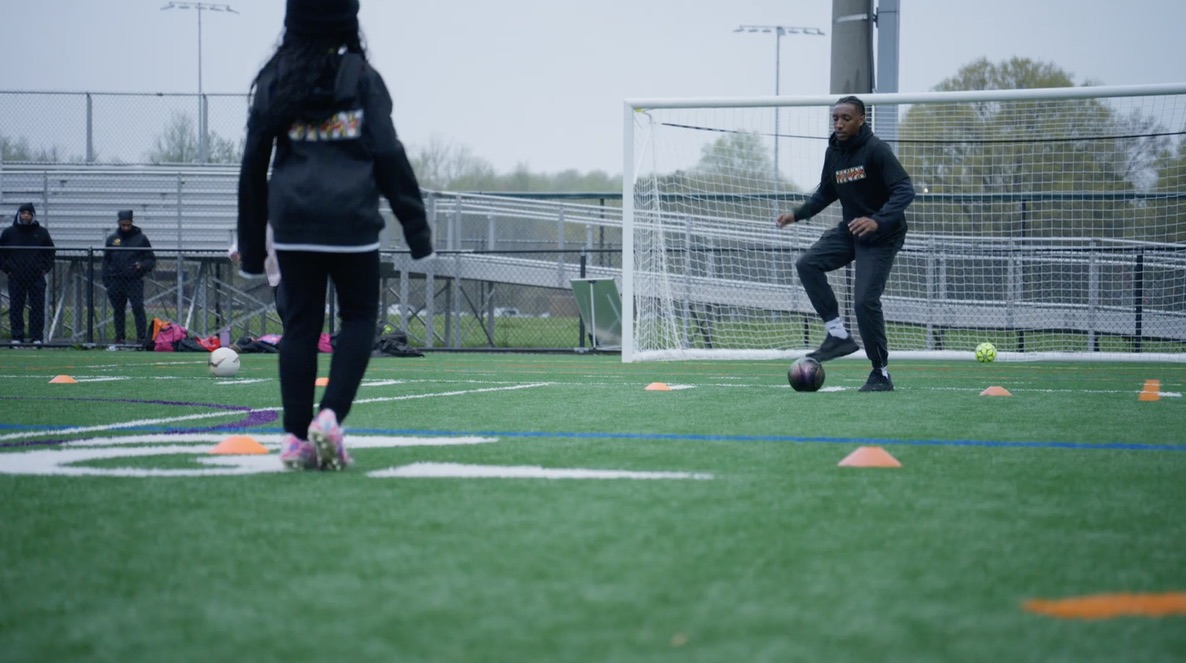
The film is not simply asking why soccer has not fully connected with Black America. It is asking why a country with endless athletic talent, cultural power, and global influence has still not built a soccer system that fully reflects the people who live here.
That question becomes sharper during the knockout rounds.
When Morocco advances, we are watching more than tactics. We are watching a national identity project. When France survives, we are watching the product of a development ecosystem shaped by migration, urban talent, elite academies, and generations of football culture. When the United States advances, as it did with a 2-0 win over Bosnia and Herzegovina, the question becomes more complicated: are we seeing real progress, or are we seeing moments of success inside a system that still has not fully opened its doors?
Can We Kick It? lives inside that tension.
The film does not treat soccer as just a sport. It treats soccer as a mirror. A mirror for race. A mirror for class. A mirror for culture. A mirror for who America develops, who America markets, and who America imagines as belonging in the game.
That is why the World Cup’s most important week is also the film’s most important week.
The deeper the tournament goes, the more obvious the film’s argument becomes. The best soccer nations do not just discover talent. They build pathways around it. They create environments where identity is not erased on the way to excellence. They understand that style, community, history, and opportunity are connected.
America still struggles with that.
The United States can host the world. It can sell out stadiums. It can build beautiful facilities. It can create massive commercial moments around the game. But the deeper question remains: can it build a soccer culture that reaches the communities whose creativity has shaped nearly every other American sport and global cultural movement?
That is not a side issue. That is the sleeping giant.
As the World Cup moves toward the quarterfinals, Can We Kick It? is not asking audiences to watch less soccer. It is asking them to watch more closely.
Watch who is on the field.
Watch where they came from.
Watch the systems behind them.
Watch the communities that produced them.
Watch the countries that turned raw talent into global identity.
And then ask the question America has avoided for too long:
What would happen if this country stopped trying to sell Americans on soccer, and started building the game with them instead?
That is the conversation Can We Kick It? is here to open.
And as the World Cup enters its most important week, that conversation is no longer ahead of the moment.
It is the moment.

Comments are closed.