
Soccer Doesn’t Need Another Commercial. It Needs an Allen Iverson.
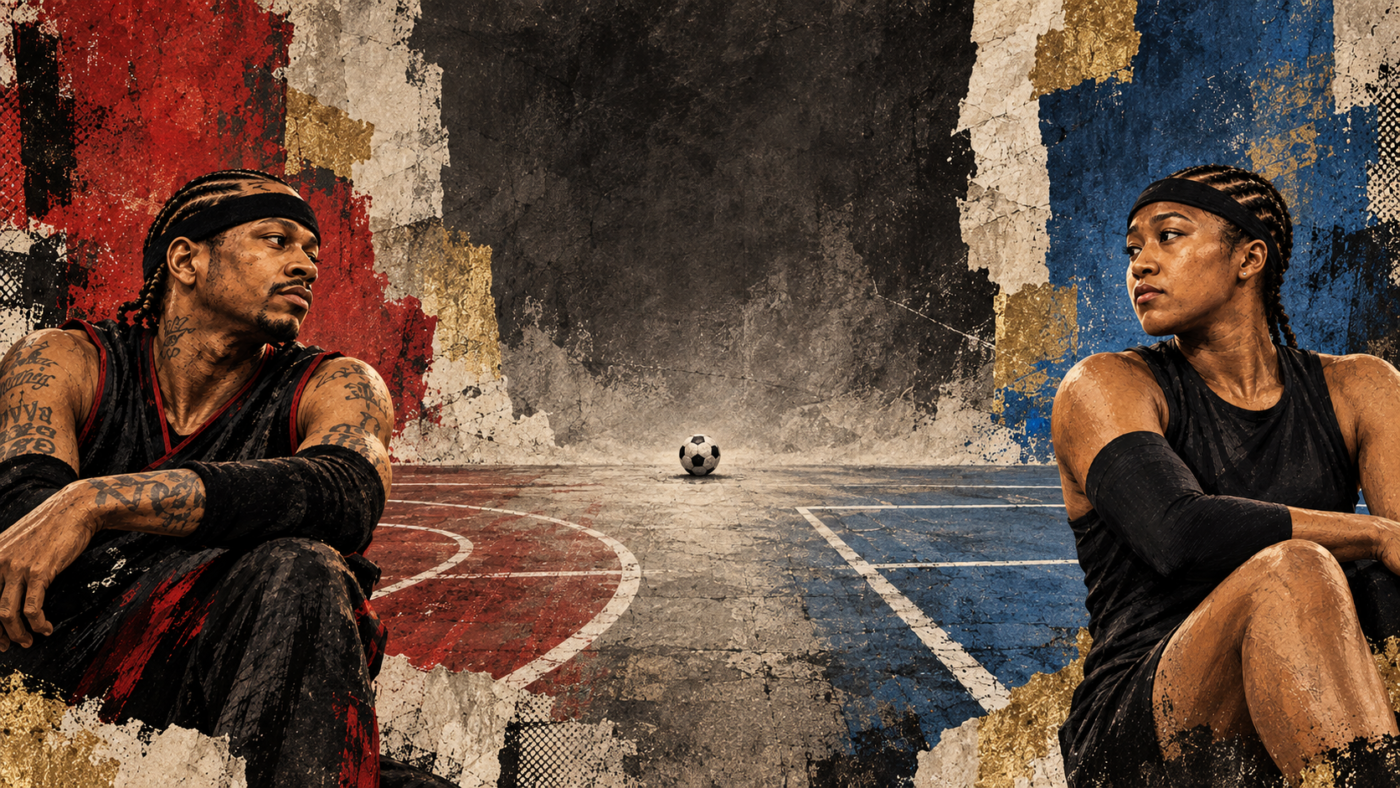
Naomi Osaka’s U.S. Open tribute showed an example of what representation looks like—and why American soccer continues to miss it.
By Akbar Majeed
Can We Kick It? Journal
The US Open is over.
But one of the images that stayed with me had nothing to do with who eventually lifted the trophy.
It was Osaka walking onto the court with cornrows, a headband and an arm sleeve, paying tribute to Allen Iverson (AI).
On the surface, it was a fashion moment. Osaka called Iverson a trailblazer and talked about how he changed the way NBA players dressed and expressed themselves.
But it was bigger than that.
Osaka comes from a different sport and a different generation. Yet when she wanted to express something about who she was as an athlete, she reached for AI.
That’s representation.
Not simply seeing someone who looks like you. Seeing someone who makes you feel like there’s room for you to be yourself.
People recognized themselves in Iverson
Iverson didn’t become important to people because the NBA developed a campaign around him.
People recognized him.
They recognized the cornrows, tattoos, clothes, toughness and attitude. They recognized the way he played—creative, fearless and unwilling to make himself smaller.
Iverson didn’t present a version of himself cleaned up to make everyone else comfortable. He carried the culture that shaped him into professional basketball, and that culture changed the league.
That is why his influence moved beyond basketball.
You did not have to play basketball to connect with him. Osaka’s tribute proved that again. Iverson gave people permission to believe that greatness did not require leaving themselves behind.
What soccer is still missing
In the film Can We Kick It?, cultural strategist Skotch Davis says that if soccer is going to connect with Black America, “it’s going to take an AI—an Allen Iverson.”
He’s not saying soccer needs a player to dress like Iverson.
He’s saying soccer needs somebody who “looks and feels like us.”
That point matters because American soccer keeps confusing visibility with connection.
It has featured Black athletes in campaigns, invited rappers to games and created ads that borrow from hip-hop.
But putting somebody from the culture next to soccer does not automatically make soccer part of the culture.
You cannot rent that relationship for a commercial and expect it to stick.
People connected with Iverson because he was not visiting the culture. He came from it—and forced the institution around him to make room for everything he represented.
American soccer has had accomplished Black players. What it has not produced is a Black American player whose presence changed how an entire community saw the game—and how the game saw itself.
This is bigger than finding a star
But an Allen Iverson doesn’t appear because a league decides it needs one.
The conditions have to exist for that person to be found, developed and allowed to remain distinctive.
Young players need access. Families need to understand the pathways. Coaches need to recognize creativity as intelligence instead of something to control. Communities need to be part of the system before someone decides they are a valuable audience.
And when a different kind of player finally appears, the game cannot ask that player to carry Black culture in the commercial while conforming everywhere that actually matters.
That is the contradiction.
Soccer wants the energy of the culture—the music, style, language and credibility—but has not done enough to let the people who create that culture shape the game itself.
Culture cannot be rented
Putting a rap song in a soccer commercial may make the commercial more interesting. It doesn’t explain why a child should love the game, why a family should invest in it or where that child can play tomorrow. It doesn’t create affordable development, coaches who understand the community or a visible pathway to opportunity.
That work is slower than advertising. It is also more durable.
Osaka’s tribute worked because it was an act of recognition. She understood what Iverson made possible and used her own stage to acknowledge him.
That is how culture travels.
American soccer says it wants to reach Black America. But reaching a community is not the same as building meaning with it.
The game doesn’t need another campaign that borrows the appearance of Black culture for a season. It needs relationships and infrastructure through which Black players, families, coaches, supporters and storytellers can shape the culture of soccer itself.
Soccer doesn’t need to manufacture its Allen Iverson.
It needs to create the conditions in which that person can arrive—and still be themselves when they do.
Comments are closed.