
Before Tuskegee, There Was Howard
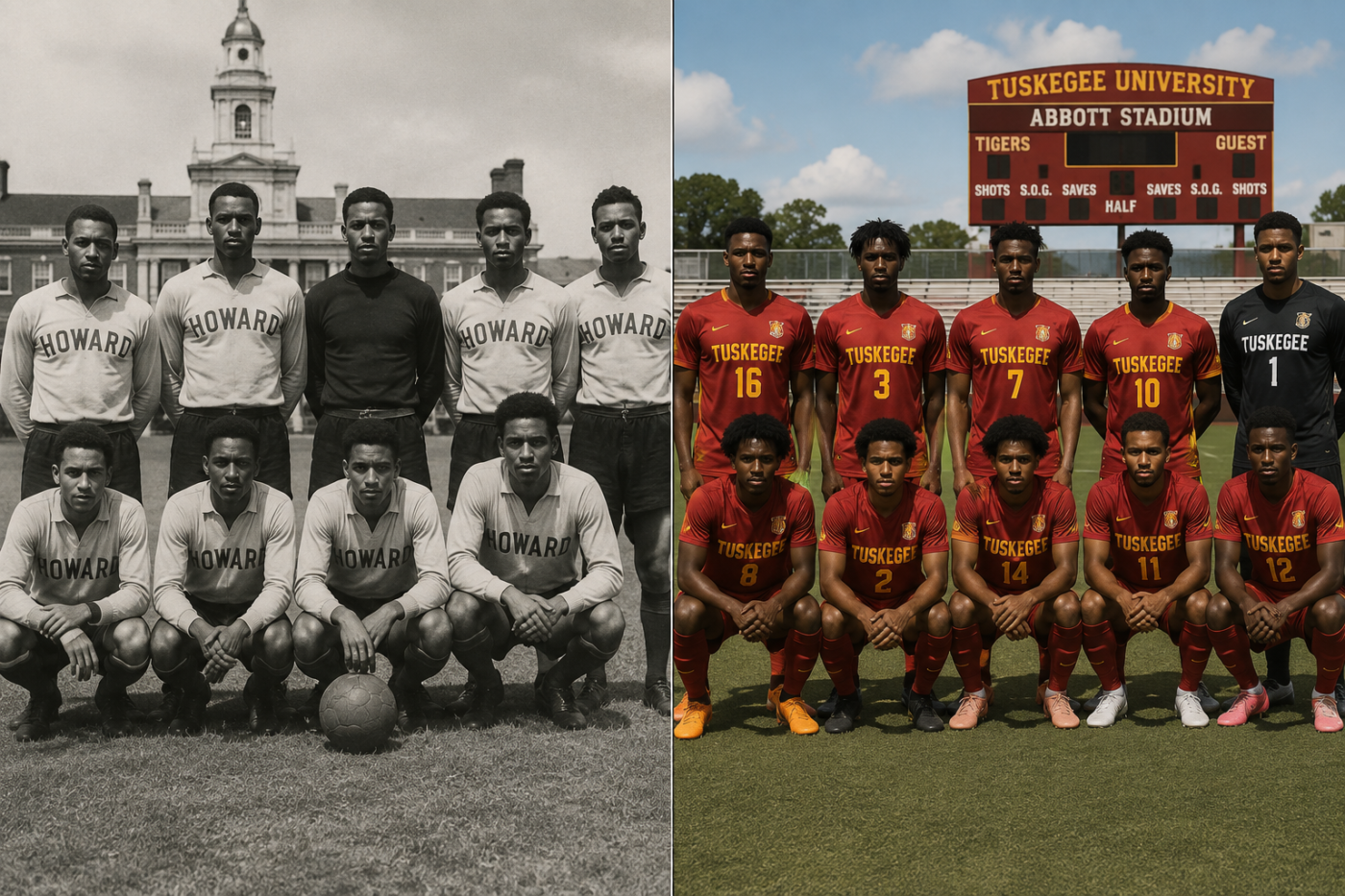
As Tuskegee launches its first men’s and women’s soccer programs, the moment points back nearly 80 years—to Ted Chambers, Howard University and one of the foundational stories of HBCU soccer.
There is something powerful about seeing a first.
This fall, for the first time in its history, Tuskegee University will field men’s and women’s soccer teams. The Golden Tigers will compete independently at the NCAA Division II level, with home matches at historic Abbott Stadium. For an institution whose name carries extraordinary weight in Black American history, the addition of the world’s game feels significant. (Tuskegee University)
And people have noticed.
The launch has generated attention not simply because Tuskegee is adding another sport, but because of what the opportunity represents. In recent coverage, Black student-athletes have talked about believing their competitive soccer careers were finished when they chose colleges that did not offer the sport.
Tuskegee is creating another possibility.
Another jersey to wear.
Another campus where a young player may not have to choose between the institution they want to attend and the game they have spent years playing.
But as new as the moment feels, the larger story is not new at all.
To understand why Tuskegee soccer matters in 2026, it is worth going back nearly eight decades.
Back to Washington, D.C.
Back to Howard University.
Back to Ted Chambers.
Building a Place for the Game
Howard University records indicate that soccer was being played at the university as early as 1931. But in 1947, James “Ted” Chambers organized a soccer club at Howard and began trying to build something more permanent. (Howard University Athletics)
What happened next says as much about America as it does about soccer.
Local white colleges would not schedule Howard.
So Chambers looked elsewhere.
For several years, Howard played teams connected to foreign embassies around Washington, D.C. The circumstances that could have limited the program instead helped shape its character. Howard’s roster drew heavily from an international student population, bringing together players and styles from different parts of the world. (Howard University Athletics)
Long before “global game” became part of American soccer’s marketing language, Howard was already living it.
An HBCU in the nation’s capital was creating its own soccer ecosystem because the existing one would not fully make room for it.
There is a familiar lesson in that.
Sometimes exclusion ends a story.
Other times, people build around it.
Chambers kept building.
He was more than a soccer coach. A Howard alumnus, professor and longtime figure in physical education and athletics, Chambers spent decades inside the university helping establish opportunities for Black students in sport. His work came during an era when Black college athletics itself was still fighting for legitimacy, resources and access. (The Hilltop Online)
Soccer became part of that work.
And eventually, what began on the margins became impossible to ignore.
In 1961, Howard won the NAIA national soccer championship, giving the university its first national athletic championship. (Howard University Athletics)
That achievement belongs to another era of American soccer—before Major League Soccer, before the explosion of youth clubs and academies, before the United States hosted multiple World Cups, and before soccer became the growth industry it is today.
Ted Chambers and Howard were already building.
Nearly Eighty Years Later
That history gives the moment at Tuskegee a different meaning.
Tuskegee President Mark A. Brown has described the new programs as a way for the university to join the global soccer community while expanding its international reach. Athletic Director Reginald Ruffin has talked about creating new opportunities for high-achieving student-athletes. (Tuskegee University)
Those ambitions make sense.
Soccer offers HBCUs something particularly interesting because the talent pool is not confined to one place.
There are Black players throughout the United States who have grown up in the game.
There are players across the Caribbean.
Across Africa.
Across Europe.
Across Latin America.
There is a global Black soccer culture that has existed for generations, even if the American college game has not always reflected it.
Howard understood some version of that possibility decades ago.
Now Tuskegee has an opportunity to interpret it for a different generation.
Not by recreating Howard.
Not by treating history as a blueprint that has to be followed exactly.
But by recognizing that HBCUs have a legitimate place in the future of American soccer because they have already been a part of its past.
The Story Ahead
The attention around Tuskegee will eventually move on.
The first practices will become regular practices. The first matches will become schedules. Recruiting classes will arrive. Programs will win, lose, adjust and try to establish themselves.
That is what building looks like.
The more interesting question is what comes after the novelty of being first.
Can Tuskegee create a sustainable pathway for Black players who want both soccer and an HBCU experience?
Can its programs attract players from beyond the traditional American recruiting pipeline?
Will other HBCUs see soccer not simply as another athletic offering, but as an opportunity to reach a growing population of players and families?
And what might happen if more historically Black institutions begin to see themselves not on the edges of American soccer, but as part of its future?
Those questions will take years to answer.
But there is value in remembering that the story did not suddenly begin in 2026.
Almost eighty years ago, Ted Chambers was trying to find someone willing to play Howard.
When doors remained closed, Howard found another way.
Eventually, they became champions.
Today, another historic Black institution is stepping onto the field.
by: C2G Journal

Comments are closed.