
In the Room: Three Cities, One Unfinished Conversation
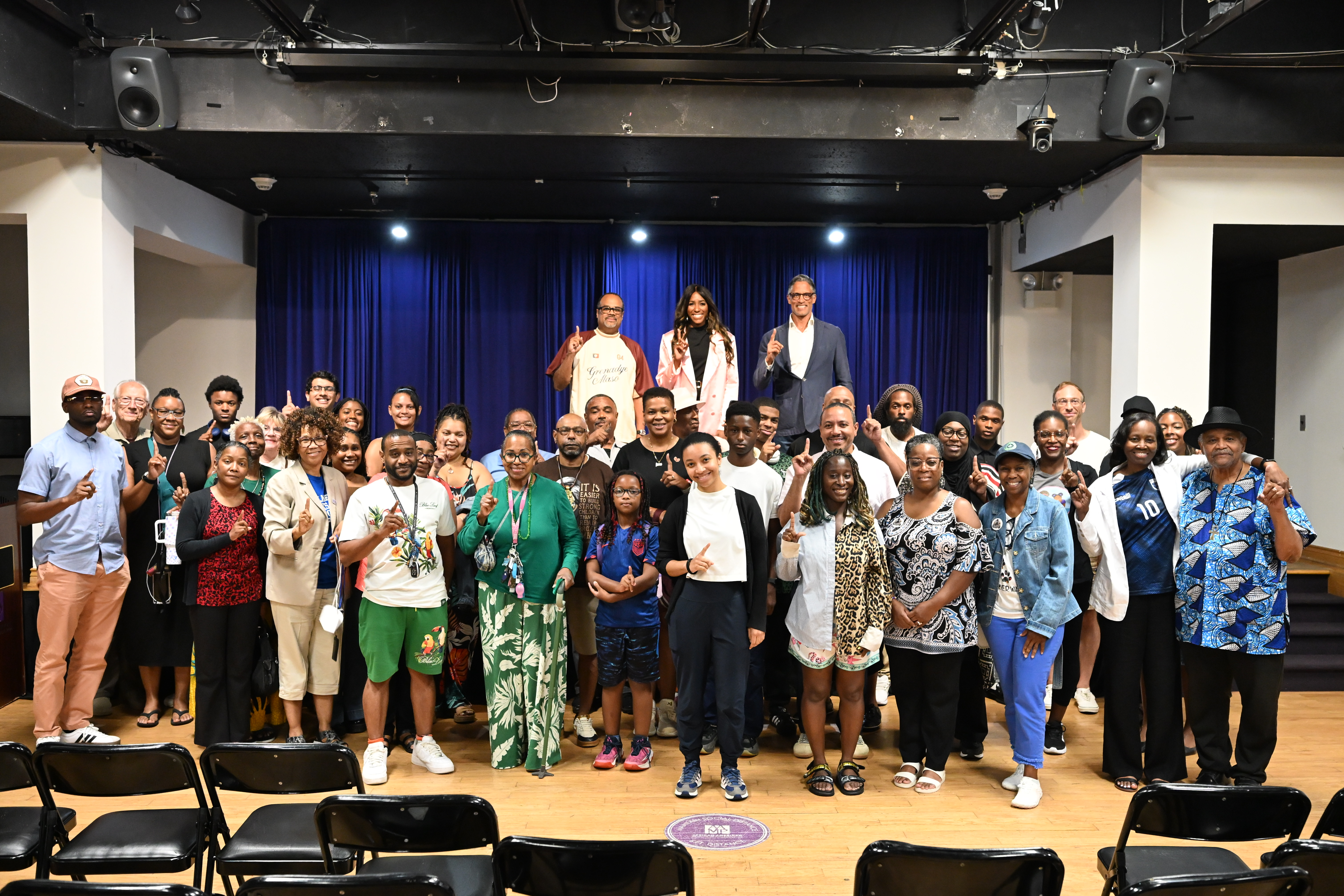
The screen went dark, but nobody was ready to leave.
That became the real story of Can We Kick It? across four screenings in Harlem, Charlotte and Philadelphia. The credits rolled, the lights came up and the questions started almost immediately.
They wanted to talk about what the documentary exposed: who has been left outside American soccer, who benefits from the system as it exists and what must change for the game to become what it keeps promising it can be.
That is what happened in the room.
Harlem: Where the Film Began—and Returned
Harlem held two different moments in the life of Can We Kick It?
The first came on May 28 at The People’s Film Festival, where the film met a public audience for the first time and received the award for Best Documentary. Harlem understands culture, creativity and reinvention—and how often communities create what institutions later learn to market.
People recognized the neighborhoods, the families carrying the cost of participation and the players who never reached the right system. The film did not feel like a new argument. It felt like a truth the room had already lived.
Nearly two months later, on July 18, we returned to Harlem for a screening and conversation at the Maysles Documentary Center.
This time, the World Cup third-place match between England and France played across the large screen behind the panel. England won a record 6–4 thriller as Bukayo Saka scored a hat trick, Kylian Mbappé scored twice and Jude Bellingham added the final goal in stoppage time.
Some of the world’s most recognizable Black players were commanding the sport’s biggest stage while, only a few feet away, we discussed why so many Black communities in America still struggle to access the game.
On the screen, the world celebrated the talent, personality and cultural power Black players bring to soccer at its highest level. In the room, the conversation centered on the neighborhoods and pathways still overlooked within the American game.
One screen showed what Black talent looks like when the pathway exists.
The conversation asked how many more players never receive one.
Charlotte: Community Before Industry
Charlotte carried a different energy.
It is part of the Concrete2Green story—a place tied to relationships, family and work that existed long before there was a completed film.
Family and friends came. North Carolina A&T was represented, alongside Spelman, Florida A&M and Alpha Phi Alpha. Bluz, whose voice opens the film, hosted the gathering.
The film did not arrive as a product dropped into a market. It returned through people already connected to the story, feeling less like an industry event and more like a community taking stock of what had been built.
American soccer often treats community as an audience segment—studying people as consumers, then marketing the game back to them.
But community is not a demographic.
It is memory. It is trust. It is who shows up before the cameras arrive and who remains after the attention moves elsewhere.
Philadelphia: History Sitting in the Present
At the African American Museum in Philadelphia, the film entered a space built to preserve and interpret Black history. That placed the conversation in a different frame.
The panel included journalist and former La Salle All-American Renee Washington and former U.S. international Don Cogsville. Philadelphia’s World Cup role was part of the discussion, but beneath it sat a larger question: what will remain after the tournament, branding and international attention disappear?
The United States knows how to host a spectacle, sell tickets and invite the world in for a summer.
But can it build something that lasts in the neighborhoods watching from outside the gates?
Can a host city invest in local fields, clubs, coaches and pathways with the same urgency it brings to major events?
They were questions connected to real neighborhoods, children and institutions.
The Questions That Followed Us
Across every screening, two questions kept returning:
What do you want to see come from the film?
And what should people do after seeing it?
Those questions tell us that audiences do not see Can We Kick It? as passive entertainment. They expect it to lead somewhere.
The answer cannot be one campaign, one sponsored field or another panel where everyone agrees that access matters. The issues are structural, requiring long-term investment, stronger community pathways and a different understanding of where American soccer’s future will come from.
Too often, institutions invite Black communities into the conversation after the strategy, budget and story have already been decided. They want participation without power, culture without ownership and visibility without meaningful investment.
The rooms made it clear that people are no longer satisfied with that arrangement.
They are not asking only to be included in someone else’s vision of American soccer.
They are asking who gets to shape it.
The Conversation Is the Beginning
These screenings confirmed that this conversation was necessary.
People have discussed pay-to-play, neglected neighborhoods, limited access and lost talent for years. What was missing was a film that connected those issues to culture, history, economics, identity and power—and placed them before audiences together.
Harlem gave us recognition.
Charlotte gave us community.
Philadelphia placed history beside the present.
Together, these rooms revealed audiences ready to move beyond outreach, diversity and good intentions. They are ready for harder questions about ownership, investment and who gets to decide what the game becomes.
The film ended in each room.
The conversation did not.
The most important thing happening around Can We Kick It? may not be what appears on the screen. It may be what people are finally willing to say once the lights come back on.

Comments are closed.